
Monday, April 15, 2013
Still Alive
It have been over 7 months since my last post. I am still alive. I have just been many, many, layers busy. We have added onto the house and I did nearly exclusively all of the work myself. While it still has a ways to go, including a new office I am currently working on, I have came to a point to gather myself and take time to enjoy a more normal pace of life and activities. That includes better updates on here.


Wednesday, September 12, 2012
Fallout 3 Character: Jason
Growing up in Vault 101 Jason devoted all his time to education. In his free time he would do intense physical training and read his favorite comic book, Grognak the Barbarian: In the Lair of the Virgin Eater. Key survival skills for him once he escaped the facility was intelligence and strength. He loved his dad very much but always knew he was holding back. Jason thought that his Dad knew about life outside the vault. He was always mad that he would not share more. Jason wanted to be a tunnel snake in his teens. The ruthless “bad-ass” gang of Vault 101. He however ended up being the baseball MVP of the vault. He could hit and pitch like no one had ever seen in 101.
The Overseer never had a favorable disposition towards Jason. On his way to escape the vault and find his father Jason killed the Overseer. He regretted it terribly. It bothered him but he could not stick around and try to work things out. He had to leave and find his dad.
At first Jason didn’t know how to act in the capital wasteland. He quickly found himself at home in the settlement of Megaton. He met some people and soon became friends with local shop owners like Moira Brown and Colin Morriarity. The town was like his base of refuge. During the day he would explore more outside of the town and the surrounding “burbs” of D.C. At night he would come and have drinks at the Brass Lantern in Megaton. He would sell and trade at local shops and was quickly becoming known as Strider to the locals.
Jason soon found out that he enjoyed donating any spare money he had to the Church. He was a regular attendee of the Church of the Children of Atom in Megaton. Later on during his travels he would attend services at Saint Monica’s Church in Rivet City.
Besides attending church Jason also found salvation in Alcohol. He found out that it was his path to happiness, since he could not find his father at the time, drinking his worries away was great. The sweet nectar also gave him a sense of being strong, so he drank almost all the time. He must have been bless because Jason never developed an addiction to beer or whiskey.
During his travels Jason came across a gang. It was lead by Goalie Ledoux, who was a ruthless thug. Jason was charismatic enough to get Ledoux alone and then slip a live grenade in his pocket. From this point on he felt he was fighting “the good fight” by cleaning up the streets of the wasteland. Goalie Ledoux had in his possession a hockey mask. Jason put on this mask and was transformed. It was like it gave him added reflexes, even if only physiological, he never wanted to take it off during a gun fight.
Jason believed that “size mattered” in the capital wasteland. He was drawn to big guns and studied how they worked. He kept all the guns he salvaged and had a massive stockpile at his house in Megaton. He also loved explosives. It was just like old times throwing a grenade as it was just like a baseball. Jason was also a pyromaniac. Fire was something seldom seen in the vault, so his favorite weapon was the “flamer”. He later found his favorite book to be 30 Handy Flame-thrower Recipes.
Fighting the good fight put Jason in dangerous situations. He decided to assault the slave camp of Paradise Falls…alone. He was jacked up on lots of alcohol and ended up killing everyone there. His attack was a total surprise and he even killed Eulogy Jones, the fiend that ran all slave trade in the capital wasteland.
After this Jason became a valuable commodity. Citizens turned to him for help but he was also hunted by mercenaries from Talon Company and other hit squads. Jason had no choice but to undergo facial reconstruction surgery in Rivet City. While recovering in the city he met Dr. Madison Li and learned a lot about his father and own personal history. Turns out Dr. Li was able to direct Jason to his father’s location. He finally tracked down his father, James, in Vault 112. They had a physical altercation but Jason agreed to help him with Project Purity.
While working on the project James was killed by the Enclave, the ruthless genocidal remnant faction of the old government. Jason seeked out his revenge. He used his superior vault education and destroyed the Enclave base and became a Brotherhood of Steel soldier in the process. He died in combat but was able to follow in his fathers footsteps fighting the good fight.
Humanity, with all its flaws, was deemed worthy of preservation. The waters of life flowed at last, free and pure for all. So ends the story of Jason. The lone wandered and strider of the wastes that stepped out from the great door of Vault 101.
The Overseer never had a favorable disposition towards Jason. On his way to escape the vault and find his father Jason killed the Overseer. He regretted it terribly. It bothered him but he could not stick around and try to work things out. He had to leave and find his dad.
At first Jason didn’t know how to act in the capital wasteland. He quickly found himself at home in the settlement of Megaton. He met some people and soon became friends with local shop owners like Moira Brown and Colin Morriarity. The town was like his base of refuge. During the day he would explore more outside of the town and the surrounding “burbs” of D.C. At night he would come and have drinks at the Brass Lantern in Megaton. He would sell and trade at local shops and was quickly becoming known as Strider to the locals.
Jason soon found out that he enjoyed donating any spare money he had to the Church. He was a regular attendee of the Church of the Children of Atom in Megaton. Later on during his travels he would attend services at Saint Monica’s Church in Rivet City.
Besides attending church Jason also found salvation in Alcohol. He found out that it was his path to happiness, since he could not find his father at the time, drinking his worries away was great. The sweet nectar also gave him a sense of being strong, so he drank almost all the time. He must have been bless because Jason never developed an addiction to beer or whiskey.
During his travels Jason came across a gang. It was lead by Goalie Ledoux, who was a ruthless thug. Jason was charismatic enough to get Ledoux alone and then slip a live grenade in his pocket. From this point on he felt he was fighting “the good fight” by cleaning up the streets of the wasteland. Goalie Ledoux had in his possession a hockey mask. Jason put on this mask and was transformed. It was like it gave him added reflexes, even if only physiological, he never wanted to take it off during a gun fight.
Jason believed that “size mattered” in the capital wasteland. He was drawn to big guns and studied how they worked. He kept all the guns he salvaged and had a massive stockpile at his house in Megaton. He also loved explosives. It was just like old times throwing a grenade as it was just like a baseball. Jason was also a pyromaniac. Fire was something seldom seen in the vault, so his favorite weapon was the “flamer”. He later found his favorite book to be 30 Handy Flame-thrower Recipes.
Fighting the good fight put Jason in dangerous situations. He decided to assault the slave camp of Paradise Falls…alone. He was jacked up on lots of alcohol and ended up killing everyone there. His attack was a total surprise and he even killed Eulogy Jones, the fiend that ran all slave trade in the capital wasteland.
After this Jason became a valuable commodity. Citizens turned to him for help but he was also hunted by mercenaries from Talon Company and other hit squads. Jason had no choice but to undergo facial reconstruction surgery in Rivet City. While recovering in the city he met Dr. Madison Li and learned a lot about his father and own personal history. Turns out Dr. Li was able to direct Jason to his father’s location. He finally tracked down his father, James, in Vault 112. They had a physical altercation but Jason agreed to help him with Project Purity.
While working on the project James was killed by the Enclave, the ruthless genocidal remnant faction of the old government. Jason seeked out his revenge. He used his superior vault education and destroyed the Enclave base and became a Brotherhood of Steel soldier in the process. He died in combat but was able to follow in his fathers footsteps fighting the good fight.
Humanity, with all its flaws, was deemed worthy of preservation. The waters of life flowed at last, free and pure for all. So ends the story of Jason. The lone wandered and strider of the wastes that stepped out from the great door of Vault 101.


Sunday, September 2, 2012
Teller Mines
Tuesday, July 24, 2012


Sunday, July 22, 2012
F.E.A.R. The Best "Forgotten" Shooter


Wednesday, June 27, 2012
Burn a British Rush
In a 1v1 automatch game last night I played a equally ranked (around
level 7) British player on Langres. My opponent tried a very
interesting approach, one I have not seen in the roughly 100 online
games I have played. He didn't bother to capture any territory but
aggressively tried to skirmish right away with infantry sections. If I
had not been prepared to be aggressive as well I would have been in bad
shape. Instead I met him with Volksgrenadiers. I was also able to gain
the entire map with Pioneers while he quickly tried to dig in on the
middle of the map with 2 MG nest and a slit trench. Normally this would
have caused me to panic but I could tell he was over extended without
grabbing any resource sections. I made a MG squad to cover my flanks
and took 2 Volks squads and Pioneers with Flamers around to flank his MG
nests. In little time his forward positions were toasted and I was
outside his base. The game lasted only 9 minutes.
 |
| Just 3 Minutes in he had MG nest and slit trench |
 |
| I flanked his position with 2 Volk and Flamer Pios |
 |
| Burned |
 |
| I moved in on his base leading to quick resign |
Tuesday, June 19, 2012
Rough Company of Heroes Notes

Wednesday, May 30, 2012
COH: Panzer Elite Press Build Order
Lately I have been exploring the RTS game franchise Company of Heroes. I have been playing with the Panzer Elite Army, they seem to fit aggressive play-style in early stages of a match. I have a basic build order that allows me to capture a good area of the map and then quickly save up resources for armor units. This allows me to press the map in my favor. Micromanagement is key with COH since there is no basic resource gathering or finite amount of resources like in other RTS games. Holding munition and fuel sectors on the map gives you more resources quicker, the key is to control the map, but also press the enemy into spending what he has.
You begin the game with a Kettenkrad, a fast moving ATV type unit that is fairly cheap. (165 man power) I build another Kettenkrad and then a Panzer Grenadier Squad in the waxing moments of the game. I use the Krad vehicles to quickly grab a large area of the map, giving priority to fuel sectors. Fuel is important early so I can build a Kampfgruppe Kompanie (220 man, 20 fuel) and a Panzer-Jager Kommand. (220 man, 30 fuel) If the map is large I will use my first Panzer infantry squad to claim territory in front of my HQ while the Krads cover the periphery. On a small map I try to immediately build a Kampfgruppe. Sometimes I will build a Logistik Kompanie at same cost first, but for this pressing strategy I prefer to wait.
 The Panzer-Jager Kommand is key to produce a couple Armored Cars as early as possible. (225 man, 25 fuel) Having a Armored Car and a grenadier squad rolling out to the front lines before 6 minutes into the game is good. This vehicle can press enemy infantry and most any other vehicle you will encounter this early in the game. The Kampfgruppe Kompanie will allow you to support Armored cars with Half-Tracks or Mortar Half-Tracks to siege enemy fortifications as the game progresses. It all depends on the situation and to make appropriate units that counter what the enemy has.
With gained experience I select the Luftwaffe Commander for off map support. Luftwaffe Infantry are very useful in an early offensive. The come in squads of 5 troops for 260 manpower. They have the ability to repair vehicles rapidly and can build defensive structures, like sandbag walls, barbed wire, or Flakvierling. Kettenkrads can also use a camo ability that helps scout ahead of the front lines. Later in a game Luftwaffe troops can build Flak 88 cannons, causing further chaos.
You begin the game with a Kettenkrad, a fast moving ATV type unit that is fairly cheap. (165 man power) I build another Kettenkrad and then a Panzer Grenadier Squad in the waxing moments of the game.
 I use the Krad vehicles to quickly grab a large area of the map, giving priority to fuel sectors. Fuel is important early so I can build a Kampfgruppe Kompanie (220 man, 20 fuel) and a Panzer-Jager Kommand. (220 man, 30 fuel) If the map is large I will use my first Panzer infantry squad to claim territory in front of my HQ while the Krads cover the periphery. On a small map I try to immediately build a Kampfgruppe. Sometimes I will build a Logistik Kompanie at same cost first, but for this pressing strategy I prefer to wait.
 The Panzer-Jager Kommand is key to produce a couple Armored Cars as early as possible. (225 man, 25 fuel) Having a Armored Car and a grenadier squad rolling out to the front lines before 6 minutes into the game is good. This vehicle can press enemy infantry and most any other vehicle you will encounter this early in the game. The Kampfgruppe Kompanie will allow you to support Armored cars with Half-Tracks or Mortar Half-Tracks to siege enemy fortifications as the game progresses. It all depends on the situation and to make appropriate units that counter what the enemy has.
With gained experience I select the Luftwaffe Commander for off map support. Luftwaffe Infantry are very useful in an early offensive. The come in squads of 5 troops for 260 manpower. They have the ability to repair vehicles rapidly and can build defensive structures, like sandbag walls, barbed wire, or Flakvierling. Kettenkrads can also use a camo ability that helps scout ahead of the front lines. Later in a game Luftwaffe troops can build Flak 88 cannons, causing further chaos.

Monday, January 23, 2012
Fallout 3 Character: Tennison
During her early days in Vault 101 Tennison was a Daddy’s Girl. She devoted all of her free time to study science and medicine. Being stuck in a Vault facility presented little opportunities growing up. The Overseer was dictator over everyone’s actions in her eyes. Even though her best friend, Amata, was the daughter of the Overseer, it didn’t help change how she felt about him.
Her peers called her a “goodie-two-shoes” because of her willingness to help others. This label was soon broken once a citizen of the wasteland. Upon hearing about her father’s “escape” from 101 she initially believed that someone in the Vault discovered something in his research and that he was executed by the Overseer. Tennison returned the favor and shot the Overseer in the head 3 times with his own 10mm Pistol.
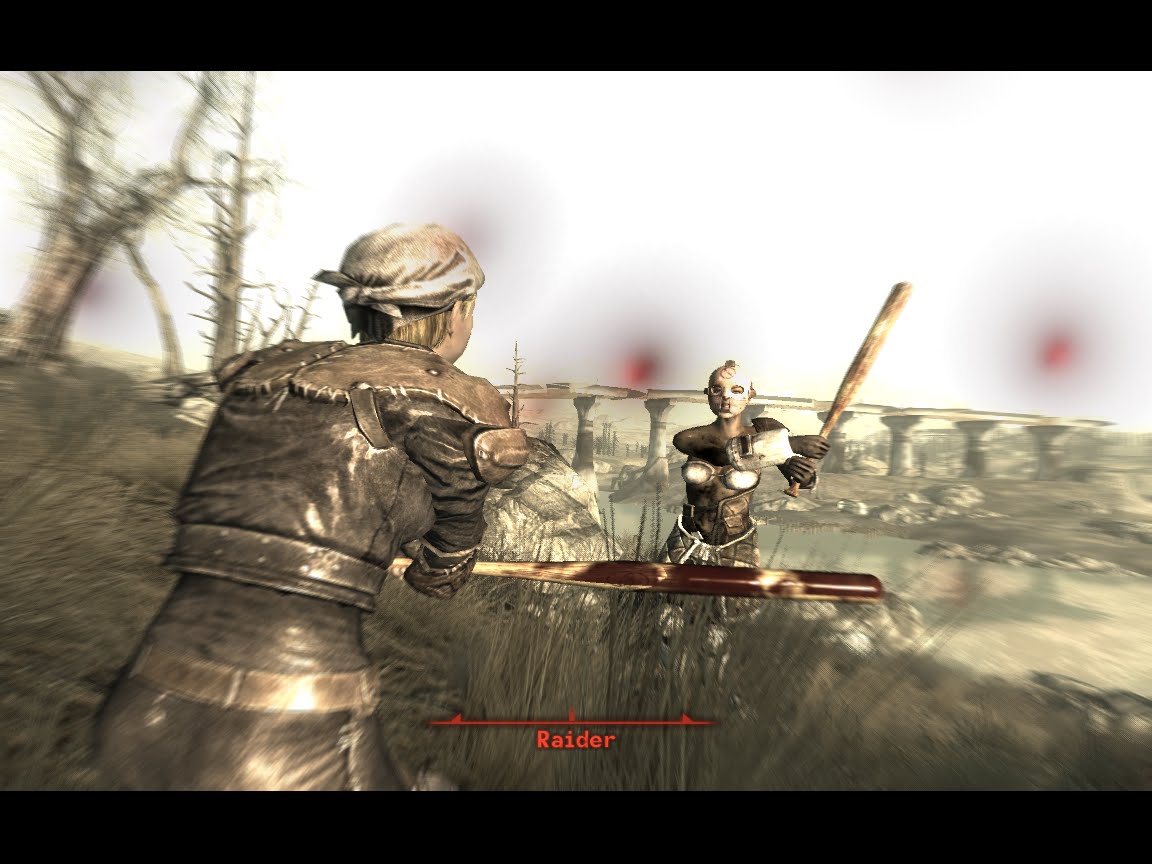
Escaping was much easier than what she thought it would be. A big part of her was frustrated that she had not gotten out of that dungeon years ago. Some raiders tried to kill Tennison with knives and pipes. They didn’t know she had a gun. She killed them and took everything they had and was quickly becoming a “gun-slinger” during any moment of tension. She wisely gave up her Vault 101 gear to blend in with the other citizens of the Wastes.
Tennison quickly became a victim of the cruel reality the wastes consisted of. Only hours after being out of the vault, being scarred and confused, she agreed to use her science skills to rig a bomb to explode for some caps. The catch was the bomb was the center of the settlement town of Megaton. It didn’t stop her. She didn’t care what happened to all the people that lived there. She wanted attention, but not the “you’re the stray from the vault” type that locals gave her the first time she walked into Megaton. She wanted to give them the finger, but not just the gesture of fuck you, but to actually wipe them off the map.
Helping blow-up Megaton gave Tennison the opportunity to live in the penthouse of Tenpenny Tower, a massive building in the Southwestern wasteland. It also gave her affiliations with Alistar Tenpenny and his henchman Burke. She would do favors for the residents of Tenpenny. Most of the time it involved murder but it was justified because she was dealing with threats to the tower and residents. After all she now lived there too.
Overtime she began to steal things. Just little things like water or food, but soon she stole to sell things for money. She later started to steal just for the thrill of it, just to take something and get away with it or she would steal to feed her addictions.
Drugs and alcohol were not something widely available in the Vault. Tennison quickly wanted to try everything the wastes could offer. Since she had a very educated background in science and medicine she quickly was able to replicate any drugs she found. She became a drug chemist and was able to develop a nice tolerance to most substances giving her the maximum potency from anything she took. During any skirmish while exploring the wastes, popping a few pills and sticking a few needles helped things go more smoothly. She didn’t think it was to serious, just some Jet or Psycho could go a long way. She also sold ingredients to other drug makers.
As time passed she started to encounter lawmen Regulators who wanted to kill her. Apparently there was a bounty placed on her head. She quickly decided to prove to everyone that the bounty was a joke. She became a Contract Killer. Anyone who tried to kill her would have their ears removed and she would sell the ears for caps. In her adventures she was quickly becoming very proficient at lock-picking, sneaking around and repairing and maintaining guns. She collected a wide variety of guns and later found her science skills helpful with energy weapons.
At the end of her travels Tennison made permanent enhanchements to her body. She became part cyborg. This gave her increased survival skills in the Wasteland, but it would not save her in the end. After stummbling into her father and his former research team, Tennison had a new vision on life, help him finish his work, or die a fiends death in the wastes. She decided to help finish his work and resist any corruption from the Enclave. At the very end, in the atrium of the Jefferson Memorial Tennison initiated the grid sequence on the project purity console, thus giving clean water to everyone in the Captial Wasteland. With this, her own life was lost as she was exposed a leathal dose of radiation in the process. In legend, no one in the wastes would forget the lone wanderer from 101 named Tennison.


Her peers called her a “goodie-two-shoes” because of her willingness to help others. This label was soon broken once a citizen of the wasteland. Upon hearing about her father’s “escape” from 101 she initially believed that someone in the Vault discovered something in his research and that he was executed by the Overseer. Tennison returned the favor and shot the Overseer in the head 3 times with his own 10mm Pistol.
Escaping was much easier than what she thought it would be. A big part of her was frustrated that she had not gotten out of that dungeon years ago. Some raiders tried to kill Tennison with knives and pipes. They didn’t know she had a gun. She killed them and took everything they had and was quickly becoming a “gun-slinger” during any moment of tension. She wisely gave up her Vault 101 gear to blend in with the other citizens of the Wastes.
Tennison quickly became a victim of the cruel reality the wastes consisted of. Only hours after being out of the vault, being scarred and confused, she agreed to use her science skills to rig a bomb to explode for some caps. The catch was the bomb was the center of the settlement town of Megaton. It didn’t stop her. She didn’t care what happened to all the people that lived there. She wanted attention, but not the “you’re the stray from the vault” type that locals gave her the first time she walked into Megaton. She wanted to give them the finger, but not just the gesture of fuck you, but to actually wipe them off the map.
Helping blow-up Megaton gave Tennison the opportunity to live in the penthouse of Tenpenny Tower, a massive building in the Southwestern wasteland. It also gave her affiliations with Alistar Tenpenny and his henchman Burke. She would do favors for the residents of Tenpenny. Most of the time it involved murder but it was justified because she was dealing with threats to the tower and residents. After all she now lived there too.
Overtime she began to steal things. Just little things like water or food, but soon she stole to sell things for money. She later started to steal just for the thrill of it, just to take something and get away with it or she would steal to feed her addictions.
Drugs and alcohol were not something widely available in the Vault. Tennison quickly wanted to try everything the wastes could offer. Since she had a very educated background in science and medicine she quickly was able to replicate any drugs she found. She became a drug chemist and was able to develop a nice tolerance to most substances giving her the maximum potency from anything she took. During any skirmish while exploring the wastes, popping a few pills and sticking a few needles helped things go more smoothly. She didn’t think it was to serious, just some Jet or Psycho could go a long way. She also sold ingredients to other drug makers.
As time passed she started to encounter lawmen Regulators who wanted to kill her. Apparently there was a bounty placed on her head. She quickly decided to prove to everyone that the bounty was a joke. She became a Contract Killer. Anyone who tried to kill her would have their ears removed and she would sell the ears for caps. In her adventures she was quickly becoming very proficient at lock-picking, sneaking around and repairing and maintaining guns. She collected a wide variety of guns and later found her science skills helpful with energy weapons.
At the end of her travels Tennison made permanent enhanchements to her body. She became part cyborg. This gave her increased survival skills in the Wasteland, but it would not save her in the end. After stummbling into her father and his former research team, Tennison had a new vision on life, help him finish his work, or die a fiends death in the wastes. She decided to help finish his work and resist any corruption from the Enclave. At the very end, in the atrium of the Jefferson Memorial Tennison initiated the grid sequence on the project purity console, thus giving clean water to everyone in the Captial Wasteland. With this, her own life was lost as she was exposed a leathal dose of radiation in the process. In legend, no one in the wastes would forget the lone wanderer from 101 named Tennison.



Wednesday, January 11, 2012
Excerpts of Stalingrad [ 3 ]
"...the fighting at Voreonezh was part of a phase for the Red Army of concentrating defence on cities, not arbitrary lines on the map. The new flexibility had allowed Timoshenko's armies to pull back, avoiding encirclement, but they had already been so badly mauled that on 12 July a new army group command-the Stalingrad Front - was established by Stavka directive. Although nobody dared voice the defeatist suggestion that the Red Army might be forced back as far as the Volga, a suspicion began to grow that this was where the main battle would have to be fought." page 75
"These seemed glorious days for German front-line regiments. "As far as the eye can see", wrote and observer, "armoured vehicles and half-tracks are rolling forward over the steppe. Pennants float in the shimmering afternoon air." Commanders stood fearlessly erect in their tank turrets, one arm raised high, waving their companies forward. Their tracks stirred up dust and propelled it outwards like smoke clouds in their wake." page 75
"Struck by the limitless horizon and expanse of sky, and perhaps also influenced by the sight of vehicles swaying crazily in and out of potholes like ships in a heavy swell, the more imaginative saw the steppe as an uncharted sea. General Strecker described it in a letter as "an ocean that might drown the invader." Villages became the equivalent of islands. In the sun-backed steppe, they also offered the most likely source of water. But a panzer commander might spot and onion-domed church tower in the distance, then on arrival, find beside it the rest of the village destroyed, perhaps with timbers still smouldering. Only the brick chimneys remained standing. The carcasses of horses and livestock lay around, their bellies swollen in the heat forcing their legs grotesquely in the air. Often, the only sign of life would be the odd cat, miaowing in the ruins." page 76
Beevor, Antony. Stalingrad: The Fateful Siege: 1942-1943. Penguin Books: New York, New York, 1998.
"These seemed glorious days for German
 front-line regiments. "As far as the eye can see", wrote and observer, "armoured vehicles and half-tracks are rolling forward over the steppe. Pennants float in the shimmering afternoon air." Commanders stood fearlessly erect in their tank turrets, one arm raised high, waving their companies forward. Their tracks stirred up dust and propelled it outwards like smoke clouds in their wake." page 75
"Struck by the limitless horizon and expanse of sky, and perhaps also influenced by the sight of vehicles swaying crazily in and out of potholes like ships in a heavy swell, the more imaginative saw the steppe as an uncharted sea. General Strecker described it in a letter as "an ocean that might drown the invader." Villages became the equivalent of islands. In the sun-backed steppe, they also offered the most likely source of water. But a panzer commander might spot and onion-domed church tower in the distance, then on arrival, find beside it the rest of the village destroyed, perhaps with timbers still smouldering. Only the brick chimneys remained standing. The carcasses of horses and livestock lay around, their bellies swollen in the heat forcing their legs grotesquely in the air. Often, the only sign of life would be the odd cat, miaowing in the ruins." page 76
Beevor, Antony. Stalingrad: The Fateful Siege: 1942-1943. Penguin Books: New York, New York, 1998.
Sunday, January 8, 2012
Layers
So far I have made some drastic changes. Nearly 90% of the content and posts of my blog have been deleted. What should I add next? Not really sure what direction this will go now. I know what I would like to add but contemplating if it is worth the time.
-Posting walk-through, build orders and screenshots for Age of Empires 3 seems counter productive since the base game is over 6 years old. Still enjoyable and would play today IF my Internet was latency free--HughsNet sucks! Still enjoy the content of the game so more content of it may appear.
-May post the basics of Company of Heroes which also is an older RTS game but, like Age 3, is intuitive enough to be a modern game experience.
-Might dig up some interesting history of RTS and FPS game development.
-I enjoy historical based games and, in turn, historical significance and awareness. This may provoke me to post historical connections and readings to content most likely addressed in a game, movie or show.
-May post content related to Fallout 3, Fallout New Vegas, and Steam.
-I was a Geography, Earth Science and Social Science student in college. News or information regarding these philosophies may be touched on time to time.
-I will NOT post any political or religious content.
-Will NOT post any agricultural content.
I have many layers [subjects] I would like to add and want to condense my labels so everything is easy to find. First objective is to not try and do everything at once.
-Posting walk-through, build orders and screenshots for Age of Empires 3 seems counter productive since the base game is over 6 years old. Still enjoyable and would play today IF my Internet was latency free--HughsNet sucks! Still enjoy the content of the game so more content of it may appear.
-May post the basics of Company of Heroes which also is an older RTS game but, like Age 3, is intuitive enough to be a modern game experience.
-Might dig up some interesting history of RTS and FPS game development.
-I enjoy historical based games and, in turn, historical significance and awareness. This may provoke me to post historical connections and readings to content most likely addressed in a game, movie or show.
-May post content related to Fallout 3, Fallout New Vegas, and Steam.
-I was a Geography, Earth Science and Social Science student in college. News or information regarding these philosophies may be touched on time to time.
-I will NOT post any political or religious content.
-Will NOT post any agricultural content.
I have many layers [subjects] I would like to add and want to condense my labels so everything is easy to find. First objective is to not try and do everything at once.
Thursday, January 5, 2012
Blog Transition
So it is a new year. I am going to take a new approach with this blog. It will no longer be agricultural related, instead it will only reflect a few nuggets of my personal interest. In the coming days and weeks I will sift out the ag related content and delete it. My new home for ag related material will be at Tumblr which will frequently be a photo blog with picture messaging while out and away from a computer. I am going to take the gloves off my Twitter feed this year as well. No more pretending, every topic is fair game; politics, music, sports, current events etc. and I plan to lay on the sarcasm. I never get reaction when I am serious so I just as well be an ass like so many others on there.
So who actually just read this post? Just say "I did" in the comments under anonymous.
This blog has been a complete failure.
So who actually just read this post? Just say "I did" in the comments under anonymous.
This blog has been a complete failure.
Sunday, February 14, 2010
Excerpts of Stalingrad [ 2 ]
 These excerpts are mainly from the part of the book over Operation Blue, the German offensive in the spring and summer of 1942 in the Ukraine and southern Russia.
"Several German panzer divisions also encountered a new form of unconventional weapon during this [outside of Moscow] fighting. They found Russian dogs running towards them with a curious-looking saddle holding a load on top with a short upright stick. At first the panzer troops thought that they must be first-aid dogs, but then they realized that the animals had explosives or anti-tank mines strapped to them. These "mine-dogs", trained on Pavlovian principles, had been taught to run under large vehicles to obtain their food. The stick, catching against the underside, would detonate the charge. Most of the dogs were shot before they reached their target, but this macabre tactic had an unnerving effect" page 35
"Field Marshal von Reichenau's notorious order to the Sixth Army of 10 October 1941, which was supported by Field Marshal von Rundstedt, quite clearly makes the Wehrmacht chain of command jointly responsible for the atrocities against the Jews and civilians in the Ukraine. "In the eastern theatre of war, the soldier is not only a man fighting in accordance with the rules of war, but also the ruthless standard-bearer of a national ideal and the avenger of all the bestialities perpetrated of the German peoples. For this reason the soldier must fully appreciate the necessity for the severe but just retribution that must be meted out to the subhuman species of Jewry." Their duty was to "free the German people forever from the Jewish-Asiatic threat"..." page 56
"For those who reached prisoner-of-war camps alive, the chance of survival turned out to be not much better than one in three. Altogether, over three million Red Army soldiers out of 5.7 million died in German camps from disease, exposure, starvation and ill-treatment. The German Army itself, not the SS nor any other Nazi organization was responsible for prisoners of war. Its attitude was reminiscent of Kaiser Wilhelm II's remark in 1914 that the 90,000 Russian prisoners captured at Tannenberg "should be left to starve"..." page 59
"[General Walther von] Seydlitz had arrived that afternoon by air from Konigsberg, where he had snatched a few days' leave with his wife, before taking over command of LI Corps under Paulus. When he and his wife had said goodbye at the airfield, they never imagined, "that is was a farewell for almost fourteen years"..." page 63
"The fighting which resulted, a gradual compression of over a quarter million Soviet troops, led to unusual situations. According to a senior NCO in the 389th Infantry Division, his grenadier regiment found itself in a merciless battle with what he described as a "bandit battalion" of women soldiers, commanded by a redhead. "The fighting methods of these female beasts showed itself in treacherous and dangerous ways. They lie concealed in heaps of straw, and shoot us in the back when we pass by"..." page 66
Beevor, Antony. Stalingrad: The Fateful Siege: 1942-1943. Penguin Books: New York, New York, 1998.
Friday, February 5, 2010
Excerpts of Stalingrad [ 1 ]

Stalingrad - The Fateful Siege: 1942-1943, is one of the most compelling books I have ever read. Years ago I had to read, for school and college, most of the time is was fairly dull reading. After college I lived alone for a while, with no dish TV and no Internet. I played some computer games and read two books by Antony Beever. The Fall of Berlin was the other.
A few weeks ago we lost power for about 20 hours so I started reading Stalingrad again at a pace of about 5-10 pages a night. I could make better progress if I just sat for a full evening or two, it is not easy to sit and read like a novel, there is much information to absorb. I have been taking time noting certain information that I am going to share on here. Some of it I find fascinating and some of it disturbing, in the end I think it is all important.
*"During that night of 21 June [1941], the diplomats in Berlin and Moscow could only guess what was happening along the frontier that separated them. Never had foreign ministries been so redundant. Some 3,050,000 German troops, with other pro-Axis armies bringing the total to four million men, awaited the invasion of the Soviet Union from Finland to the Black Sea. "The world will hold its breath!" Hitler had declared at a planning session several months before...
In the 24th Panzer Division, for example, Captain von Rosenback-Lepinski is said to have told his motorcycle recon battalion: "The war with Russia will last only four weeks." Such confidence was, in many ways, understandable. Even foreign Intel services expected the Red Army to collapse. The Wehrmacht had assembled the largest invasion force ever seen, with 3,350 tanks, around 7,000 field guns and over 2,000 aircraft...the Wehrmacht famed for its Blitzkrieg, also depended on over 600,000 horses to tow guns and ration wagons...
Hitler's plans of subjugation and exploitation could only strengthen the "rotten structure" [Hitler believed Russian was a rotten structure, which if you crash in the front door the whole thing will crumble down] by forcing even those who loathed the Stalinist regime to support it. Stalin and the apparatus of the Communist Party quickly recognized the need to shift their rhetoric away from Marxist-Leninist cliches. The phrase "The Great Patriotic War" appeared in a headline in the first issue of Pravda to appear after the invasion, and Stalin himself soon took up this deliberate evocation of the Patriotic War against Napoleon...
The infantry divisions, which composed the bulk of the army, were marching up to forty miles a day, their jackboots roasting in the summer heat. The Landser, or infantryman, carried about fifty-five pounds of equipment, including steel helmet, rifle, ammunition and entrenching tool. His canvas and leather pack contained a mess tin, canteen, an Esbit field stove, a combined spoon and fork in aluminium, rifle cleaning kit, spare clothes, tent pegs and poles, field dressing, sewing kit, razor, soap and Vulkan Sanex condoms, even though carnal relations with civilians were officially forbidden..."
*Beevor, Antony. Stalingrad: The Fateful Siege: 1942-1943. Penguin Books: New York, New York, 1998.
Thursday, January 28, 2010
Apocalypse Man
A terrific show with lots of potential is "Apocalypse Man" from the History Channel. So far there is only one episode that aired this month. I hope for more but even if it only comes to the pilot it has risen my awareness several notches.
Rudy Reyes is a former Recon Marine who in the past decade has spent 3 tour of duties over seas. On this show he demonstrates several ways to survive and make the most out of resources in the event of a world apocalyptic disaster.
Reyes makes a fire with steel wool, shows how to syphon gas with a bike pump, and how to make on the fly field brewed bio-diesel. He also gives ideas on how to obtain information in a powerless world and how to open communication with others. For me I find it important how he indicates that if martial law happens, you need to know how to deal with people on your terms.
Try it out, check your listings. I have the DVR set to record any episodes, I can only hope for a few more, it really is the most interesting show I have seen in a while.
Rudy Reyes is a former Recon Marine who in the past decade has spent 3 tour of duties over seas. On this show he demonstrates several ways to survive and make the most out of resources in the event of a world apocalyptic disaster.
Reyes makes a fire with steel wool, shows how to syphon gas with a bike pump, and how to make on the fly field brewed bio-diesel. He also gives ideas on how to obtain information in a powerless world and how to open communication with others. For me I find it important how he indicates that if martial law happens, you need to know how to deal with people on your terms.
Try it out, check your listings. I have the DVR set to record any episodes, I can only hope for a few more, it really is the most interesting show I have seen in a while.
Tuesday, October 27, 2009
Impartial Mediation
For several weeks now I have wanted to write about many topics. From football to the non-existent fall harvest to politics and music and porcelain tile. It is one thing to sit around and have many ideas going on in my head it is another thing to type out exactly what I want to express. Rarely, if ever, can that be done to get my view across.
Sometimes I question the overall "Validity" of my site. It could be used in a manner to bring about awareness of issues that affect agriculture. It could be entirely a ridiculous site full of made up news, I did that years ago with a homepage at geocities. I could just blog about overall immature computer gaming that I do in the evenings. I could make it a combination of many things. In the end I wonder if anyone who might be reading this cares. Maybe whether or not "they" or "you" care it should only matter if I care. Ultimately I do. I then run into the same problem that my wife has with her blog. Judgement.
With a basic audience of a few, and I really mean few friends and even fewer family, what can I write about or post that would spark a morsel of interest. I have 2 listed followers. I can post all types of shit that I feel is interesting but do any of the readers here actually care? What if I write all crazy about ethics, religion, politics...would the views I share distance some of the few readers I have? Or perhaps the views I have might be equally shared among some readers.
The bottom line is that the feeling of being "judged" does influence what I post. Some topics I really don't care how people feel about. Like my babe and cougar of the month feature. It is mostly done for entertainment and it also forces me to update my site. The same is true for use-less babble like Fallout 3 character playthroughts. My wife reads them. That's about it. I assume others role their eyes. Some topics I have been reluctant to touch. Those pesky sensitive issues like gay-marriage and health care and foreign wars. I usually figure that people get enough of that from the news, or that my opinion maybe disliked or perhaps just surprising. I also run the risk of self arraignment on a very small degree, but people can change views over time. For example, a decade ago I was full fever in favor of the death penalty, today I feel the system has serious flaws and do no agree to it.
I have found a possible solution to this dilemma. Impartial Mediation. Which is defined as:
Impartiality is a principle that decisions should be based on objective criteria, rather than on the basis of bias, prejudice, or preferring the benefit to one person over another for improper reasons. While Mediation, in a broad sense, consists of a cognitive process of reconciling mutually interdependent, opposed terms as what one could loosely call "an interpretation" or "an understanding of".
With this, I can post whatever I feel like and not have to worry about being judged. Well of course I will still be judged but that lies more in the individual reader than the audience as a whole. If I present my views and feelings using impartial mediation then a vast number of readers will at least respect my opinions, with this their judgement becomes null.
Basically, if I want to post the Husker offense sucks I can. I just need objective criteria, independent of bias, with controlled understanding and explanation of why they suck. If I want to post why Barack Obama is a communist, I just need objective criteria, independent of bias, with controlled understanding and explanation of why I think he is a communist. If I want to post why George Bush is a complete idiot, I just need objective criteria, independent of bias, with controlled understanding and explanation of why he is a complete idiot.
The only problem is...I have already know how to solve this, I just need to implement it.
Sometimes I question the overall "Validity" of my site. It could be used in a manner to bring about awareness of issues that affect agriculture. It could be entirely a ridiculous site full of made up news, I did that years ago with a homepage at geocities. I could just blog about overall immature computer gaming that I do in the evenings. I could make it a combination of many things. In the end I wonder if anyone who might be reading this cares. Maybe whether or not "they" or "you" care it should only matter if I care. Ultimately I do. I then run into the same problem that my wife has with her blog. Judgement.
With a basic audience of a few, and I really mean few friends and even fewer family, what can I write about or post that would spark a morsel of interest. I have 2 listed followers. I can post all types of shit that I feel is interesting but do any of the readers here actually care? What if I write all crazy about ethics, religion, politics...would the views I share distance some of the few readers I have? Or perhaps the views I have might be equally shared among some readers.
The bottom line is that the feeling of being "judged" does influence what I post. Some topics I really don't care how people feel about. Like my babe and cougar of the month feature. It is mostly done for entertainment and it also forces me to update my site. The same is true for use-less babble like Fallout 3 character playthroughts. My wife reads them. That's about it. I assume others role their eyes. Some topics I have been reluctant to touch. Those pesky sensitive issues like gay-marriage and health care and foreign wars. I usually figure that people get enough of that from the news, or that my opinion maybe disliked or perhaps just surprising. I also run the risk of self arraignment on a very small degree, but people can change views over time. For example, a decade ago I was full fever in favor of the death penalty, today I feel the system has serious flaws and do no agree to it.
I have found a possible solution to this dilemma. Impartial Mediation. Which is defined as:
Impartiality is a principle that decisions should be based on objective criteria, rather than on the basis of bias, prejudice, or preferring the benefit to one person over another for improper reasons. While Mediation, in a broad sense, consists of a cognitive process of reconciling mutually interdependent, opposed terms as what one could loosely call "an interpretation" or "an understanding of".
With this, I can post whatever I feel like and not have to worry about being judged. Well of course I will still be judged but that lies more in the individual reader than the audience as a whole. If I present my views and feelings using impartial mediation then a vast number of readers will at least respect my opinions, with this their judgement becomes null.
Basically, if I want to post the Husker offense sucks I can. I just need objective criteria, independent of bias, with controlled understanding and explanation of why they suck. If I want to post why Barack Obama is a communist, I just need objective criteria, independent of bias, with controlled understanding and explanation of why I think he is a communist. If I want to post why George Bush is a complete idiot, I just need objective criteria, independent of bias, with controlled understanding and explanation of why he is a complete idiot.
The only problem is...I have already know how to solve this, I just need to implement it.
Sunday, June 7, 2009
World In Conflict
As I had mentioned months ago, World In Conflict is a fictional game based on a Cold War that turns hot in the late 1980's. The story of it was written by Tom Clancy, but the most enjoyment offered is through online cooperative play. You join a side, either as Russia or as NATO/USA.
You battle on a variety of detailed maps for command points and domination. You play as a team, up to 8 v 8 games. There are 4 different combat roles to play, so each team must balance the roles and adapt. The roles include Infantry, Armor, Air, and Support. I can play all fairly well except Air. You also earn tactical aid points which you spend on a variety of aids. If you are pestered by infantry troops in an urban region you can call in a chemical strike, or have an A-10 rip tanks apart with cannon shot. Napalm a forest to clear the way for tanks, or call in the most expensive aid-the tactical nuke.
You battle on a variety of detailed maps for command points and domination. You play as a team, up to 8 v 8 games. There are 4 different combat roles to play, so each team must balance the roles and adapt. The roles include Infantry, Armor, Air, and Support. I can play all fairly well except Air. You also earn tactical aid points which you spend on a variety of aids. If you are pestered by infantry troops in an urban region you can call in a chemical strike, or have an A-10 rip tanks apart with cannon shot. Napalm a forest to clear the way for tanks, or call in the most expensive aid-the tactical nuke.
Sunday, April 26, 2009
Age 3: part 4
 Spain- Have good hand infantry and cavalry available, and are flexible early in the game due to their faster Home City shipments. The Spanish explorer can train War Dogs since the Discovery Age, when soldiers are not trainable. Their unique units are the Rodelero, Lancer and Missionary.
British- Build Manors, which are 35% more expensive than normal houses, but spawn one free settler each upon construction, instead of the usual houses; this speeds up early game construction and gathering. Their military is more focused on the later game, with a stronger economy in the early game. Their unique units are the Longbowman, which boast the longest range in the game, and Rocket.
French- Train Coureurs des bois, stronger villagers which may eventually double as infantry. This civilization can have many shipments related to Natives, and so it is the strongest at forging native alliances. The French train the strongest cavalry unit of the game, the Cuirassier. Their unique units are the Cuirassier and the Coureur des Bois.
Portuguese- Receive a free covered wagon on each age advancement, which can build a free town center. This civilization has extra exploring facilities, such as the option of shipping additional explorers and the "spyglass" ability which can reveal unexplored territory. They have a balanced military, which is supplemented by a strong navy. Their unique units are the Cassador and Organ gun.
Dutch- Settlers cost coin instead of food, making them dependent on this resource from the very start of the game; this disadvantage is, however, countered with the revenue produced by Banks, coin-generating buildings unique to the Dutch. Their unique units are the Envoy, Ruyter and Fluyt.
Russians- Train numerous units in groups, speeding up production—especially early in the game. This gives them the capacity to overwhelm other players with their large armies, which are supplemented by the low cost of their military and, for the most basic units, a weaker army unless strenght in numbers. Their unique units are the Strelet, Cossack and Oprichnik.
Germans- Represent all of the Central European kingdoms of the time and start out with settler wagons instead of the normal European settlers. The German Home City ships settler wagons which are equivalent to two regular settlers. Their military develops steadily because Uhlan cavalry are given as a bonus along with most shipments. Also, the Germans can ship mercenaries sooner than any other civilization. Their unique units are the Doppelsoldner, Uhlan, War Wagon and Settler Wagon.
Ottoman- Economy is slow but constant, due to the fact that settlers are continually produced automatically at no cost but have the disadvantage of having limited settler production. The Ottoman military makes heavy use of artillery units, many of them unique, such as the Great Bombard, the most powerful artillery unit in the game. The Ottomans lack light infantry: the only infantry they can train is the Janissary, a more powerful type of musketeer. Their unique units are the Janissary, Abus Gun, Spahi, Great Bombard, Galley and Imam. The Ottomans specialize in early game combat because of their quick gain in economy.
Iroquois- War Chief boosts hitpoints of nearby units, have Travois, which can build most buildings for free. They start with one Travois. They also have a unique Founder Dance in the fire pit which spawns Travois. They also receive a Travois or two on each age advancement. Entire army is unique, most ranks are filled with Tomahawks and Forest Prowler infantry.
Sioux- War Chief boosts speed of nearby units, starts with 200 population slots automatically, but cannot build walls. Have unique Teepees, to provide a little health bonus and damage bonus to nearby, friendly units. Very nomadic civ that can move very freely with very few structures. Horse heavy units include Axe Riders and Rifle Riders. Dog Soldiers are powerful cavarly trained at a firepit ceremony.
Aztecs- War Chief bonus doubles experience gained in combat by nearby units, have warrior priests that can heal or firepit dance. They start with one Warrior Priest. Very good at farming and fishing. War canoes can control water very well and with priests available early they can thrive economically. They only train infantry units, but have several warriors and knights filling specific combat roles.
India- This civilization has no villager cards at the Home City, but they receive one villager with almost every shipment. All villagers that are not shipped from the Home City cost wood instead of food. Villagers are also not allowed to harvest livestock for food, but instead can build a structure called a Sacred Field which will generate experience points whenever livestock are tasked to it. Sepoys, Gurkha and Rajputs are the primary infantry units, and India has several types of camel and elephant cavalry. Both of India's monks ride atop elephants and can heal other units from the start of the game.
China- The Chinese get only one monk along with a disciple at the start of the game, the monk is the only 'explorer unit' who can train military units (trains disciples) during the "discovery age" and has the largest attack points compared to any other monk or explorer. The Chinese have a higher population limit than all the other civilizations; up to 220 population points, rather than the usual 200. Additionally, their military units are trained in blocks, much like the Russians, except that each block trains two different unit types in Banner Armies.
Japan- This civilization has the Daimyo and Shogun units. Japanese villagers cannot gather food via herding or hunting, but can build shrines near huntable and herdable animals to gain a slow trickle of food, wood, or coin. The shrines also act as houses, supporting 10 population units. They have the unique ability to ship most cards twice. They can field a very strong army consisting of Yumi archers, Ashigaru musketeers and flaming arrow siege units, and of course Samurai.
Saturday, April 18, 2009
Age 3: part 3
In Age of Empires 3 you gather resources in your virtual world. There are dozens of possible locations that a random game can be played on. The most popular is The Great Plains, due to the large open spaces for building, good natives to ally with and hoards of buffalo to hunt. The detailed geography of each map was well done. You can play anywhere in the New World and Orient from Indochina to New England to California to the Patagonia to the Yukon. Each map has certain characteristics that might help or hinder your preferred strategy. You really have to adapt to be successful.
At the beginning of each game you start with a Town Center, a New World Explorer and some colonists who collect resources. You also start with a small amount of supplies in crates. The amount of stuff you have and number of villagers varies for each civilization. Usually it is around 5-7 villagers and maybe 500-1000 in total resources.
Food: Gathered by hunting, foraging for berries, fishing and farming. Livestock such as cattle and sheep can also provide food. Food is needed to train most units and is essential to your colonies survial.
Wood: Gathered slower than other resources, is need to build structures and upgrade units. It is also important for training units like Crossbowmen and Pikemen. It is collected by chopping trees.
Coin: Gathered from mines and from plantations. The more wealth you have the more improved your army and colony grows. It is also integral for bribing foreign mercenaries to fight in your battles.
XP: Experience is gathered through building and fighting. The more XP you get the more influence your Home City- the base of which your settlement receives aid- can provide to your new colony. They might be able to send additional villagers, shipments of resources or military troops and improvements. Sometimes a well timed home city shipment could mean the survival of your colony.
All resources and XP can be gained at Trade Posts. Trade posts are sturctures that you must build at pre-determined locations on a map. Some maps have several posts, others have very few or none. Trade posts are also built at native villages to provide military aid or other helpful aids. All resources can be generated at Factories later in the game. Factories are available from a home city shipment once your colony advances to the Industrial Age.


At the beginning of each game you start with a Town Center, a New World Explorer and some colonists who collect resources. You also start with a small amount of supplies in crates. The amount of stuff you have and number of villagers varies for each civilization. Usually it is around 5-7 villagers and maybe 500-1000 in total resources.
Food: Gathered by hunting, foraging for berries, fishing and farming. Livestock such as cattle and sheep can also provide food. Food is needed to train most units and is essential to your colonies survial.
Wood: Gathered slower than other resources, is need to build structures and upgrade units. It is also important for training units like Crossbowmen and Pikemen. It is collected by chopping trees.
Coin: Gathered from mines and from plantations. The more wealth you have the more improved your army and colony grows. It is also integral for bribing foreign mercenaries to fight in your battles.
XP: Experience is gathered through building and fighting. The more XP you get the more influence your Home City- the base of which your settlement receives aid- can provide to your new colony. They might be able to send additional villagers, shipments of resources or military troops and improvements. Sometimes a well timed home city shipment could mean the survival of your colony.
All resources and XP can be gained at Trade Posts. Trade posts are sturctures that you must build at pre-determined locations on a map. Some maps have several posts, others have very few or none. Trade posts are also built at native villages to provide military aid or other helpful aids. All resources can be generated at Factories later in the game. Factories are available from a home city shipment once your colony advances to the Industrial Age.


Subscribe to:
Posts (Atom)